You see a patient for an hour. The other 167 happen without you. Digital Wellness Academy gives your patients skills to practice between visits, gives you a safety net that watches for distress in real time, and gives you a portal where you walk into every session already knowing what changed. White-label, HIPAA-ready, and built so the AI supports your judgement instead of replacing it.
Not a content library you bolt on and forget. Four systems that work together so your care reaches past the appointment.
Assign courses to a patient's care plan and they practice real skills, guided breathing, thought records, grounding, in the moments you cannot be in the room.
MAIA checks every patient text for distress before anything else, surfaces 988 to the patient, and raises a confidence-scored alert to you, ranked by urgency.
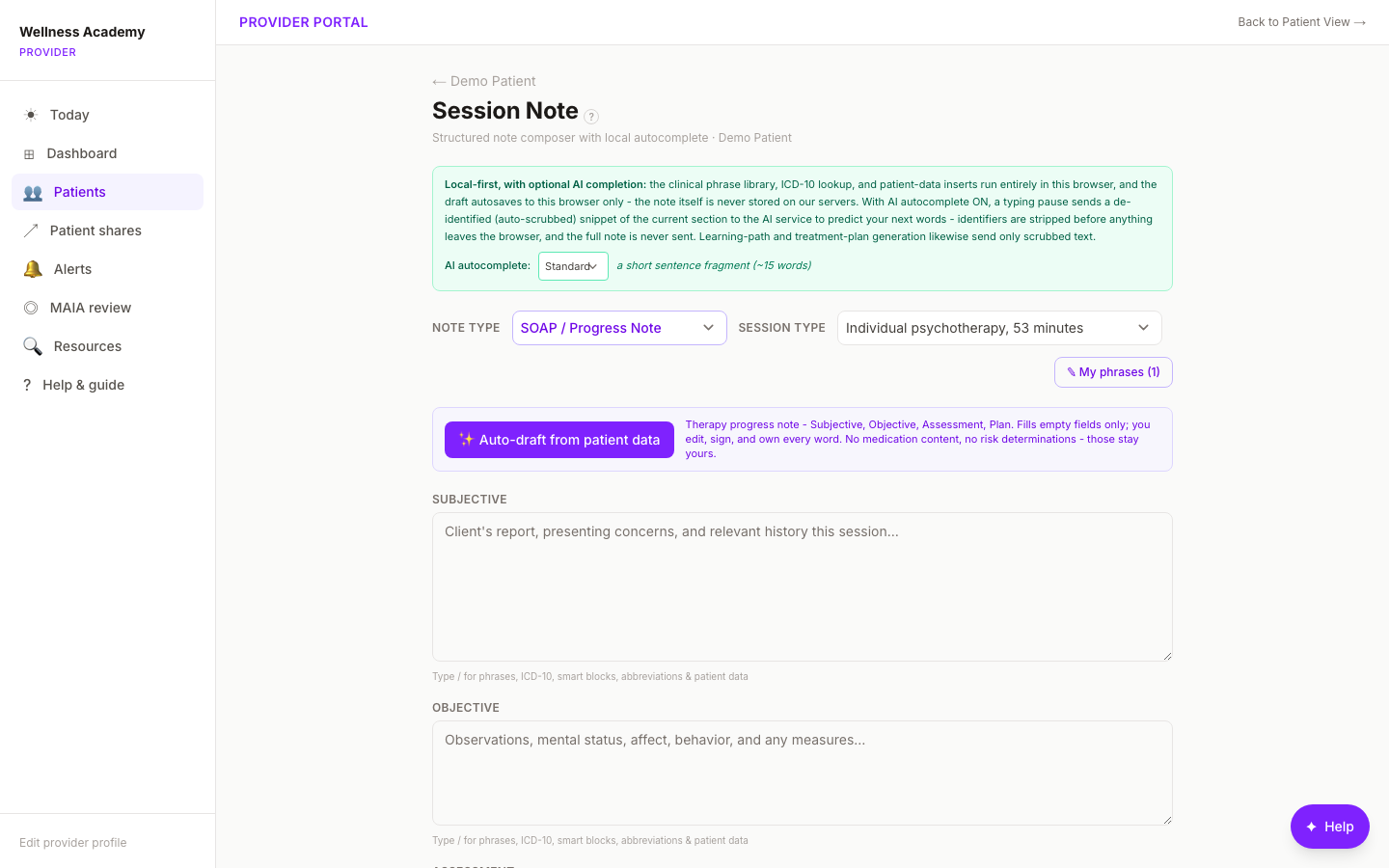
A SOAP composer auto-drafts from patient data and runs locally, never stored on our servers. You edit, sign, and own every word. Medication and risk language stays yours.
GAD-7 and PHQ-9 trends, mood and anxiety trajectories, engagement, and distress episodes, tracked over time so progress is something you can see and defend.
Composite practitioners, running real workflows. The screenshots below follow them through the portal.
Dr. Chen runs a solo telehealth practice in anxiety, depression, and trauma-informed care. She licenses Digital Wellness Academy so a small panel of patients keeps practicing between visits, gets notified the moment the classifier flags distress, and walks into each session already knowing what changed.
Capacity without headcount. Patients do guided work between visits, so each session starts further along.
A floor under risk. Distress is surfaced in real time, not discovered at the next appointment.
Less time on notes. The composer drafts from real data; she edits and signs.
Defensible progress. GAD-7 and PHQ-9 trends she can show patients, referrers, and payers.
Dr. Patel owns a cash-pay group therapy practice. His problem is not a single hour of session time, it is that six clinicians each hand out homework differently and the practice's clinical quality varies by who a patient happens to see. He licenses Digital Wellness Academy, under his own brand, as the standard curriculum every clinician assigns.
One clinical standard, not six. Every clinician assigns from the same reviewed curriculum, so care quality does not depend on who a patient was scheduled with.
A brand patients associate with the practice. White-label means the education looks like the practice's own program, which matters when the practice competes on reputation, not insurance panels.
No distraction from the session itself. Assignment and monitoring live in the portal, not the therapy hour. Nothing about the platform asks a clinician to change how they run a session.
Practice-wide visibility. He can see engagement and outcome trends across the whole panel, not just the patients he personally sees.
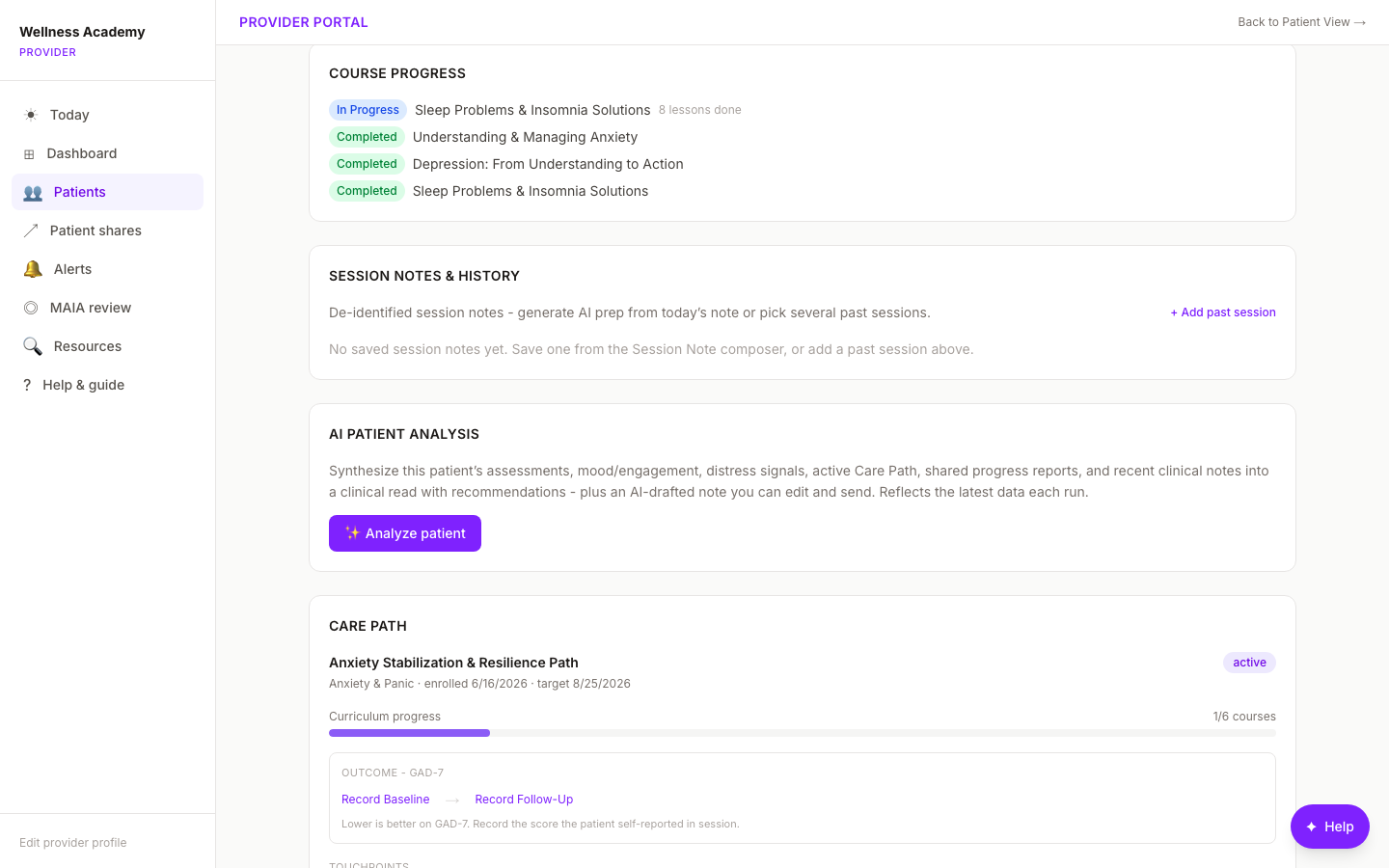
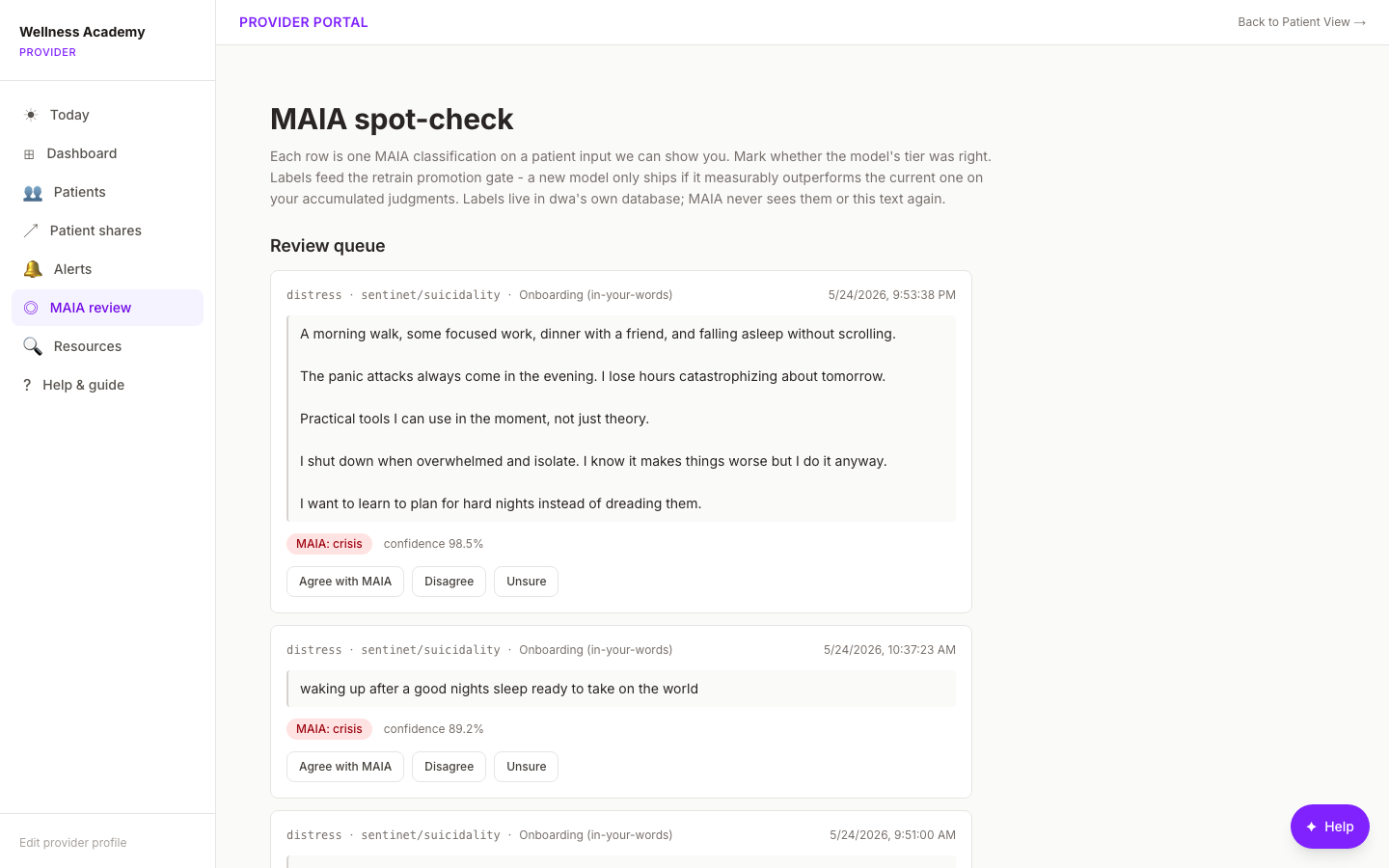
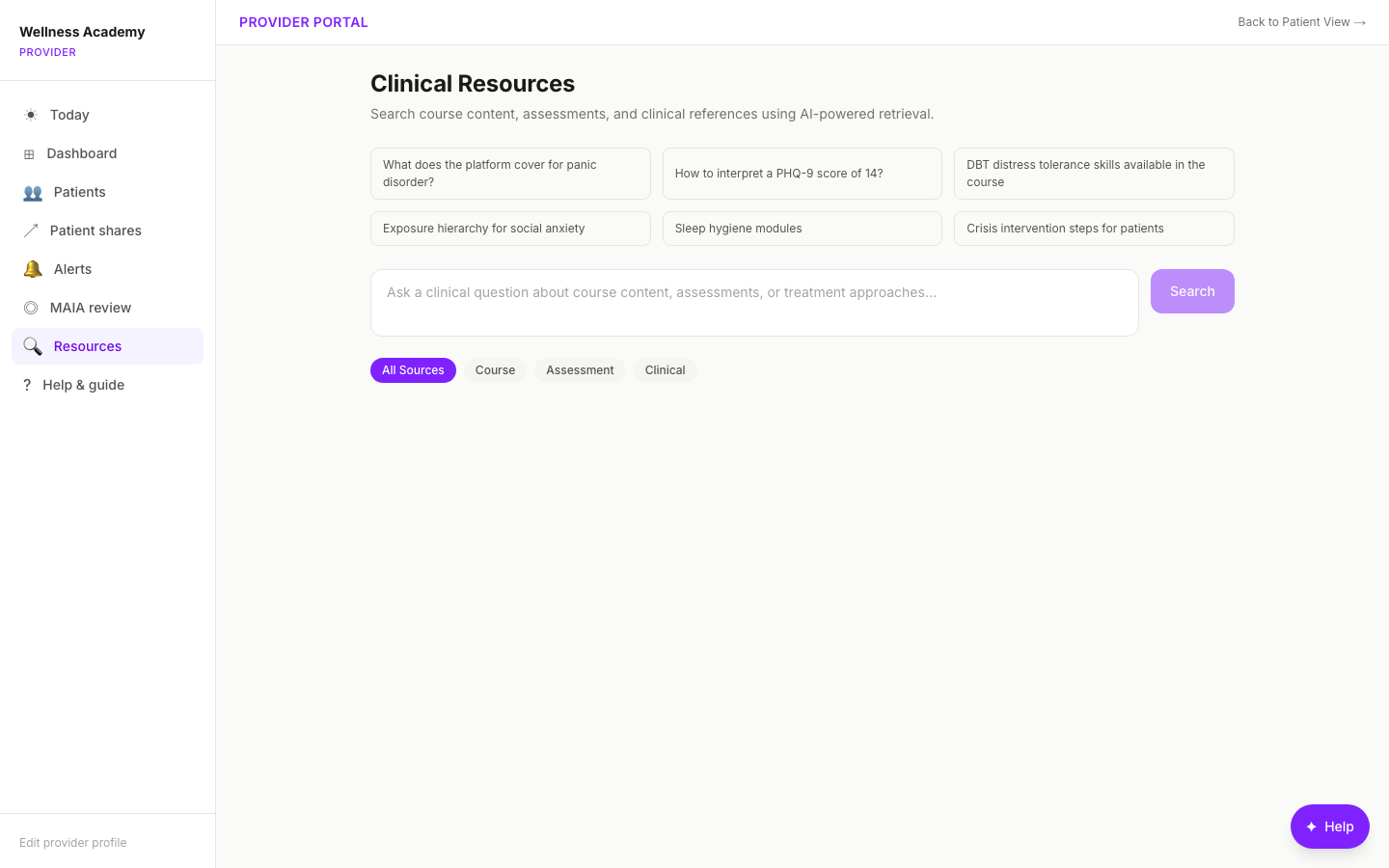
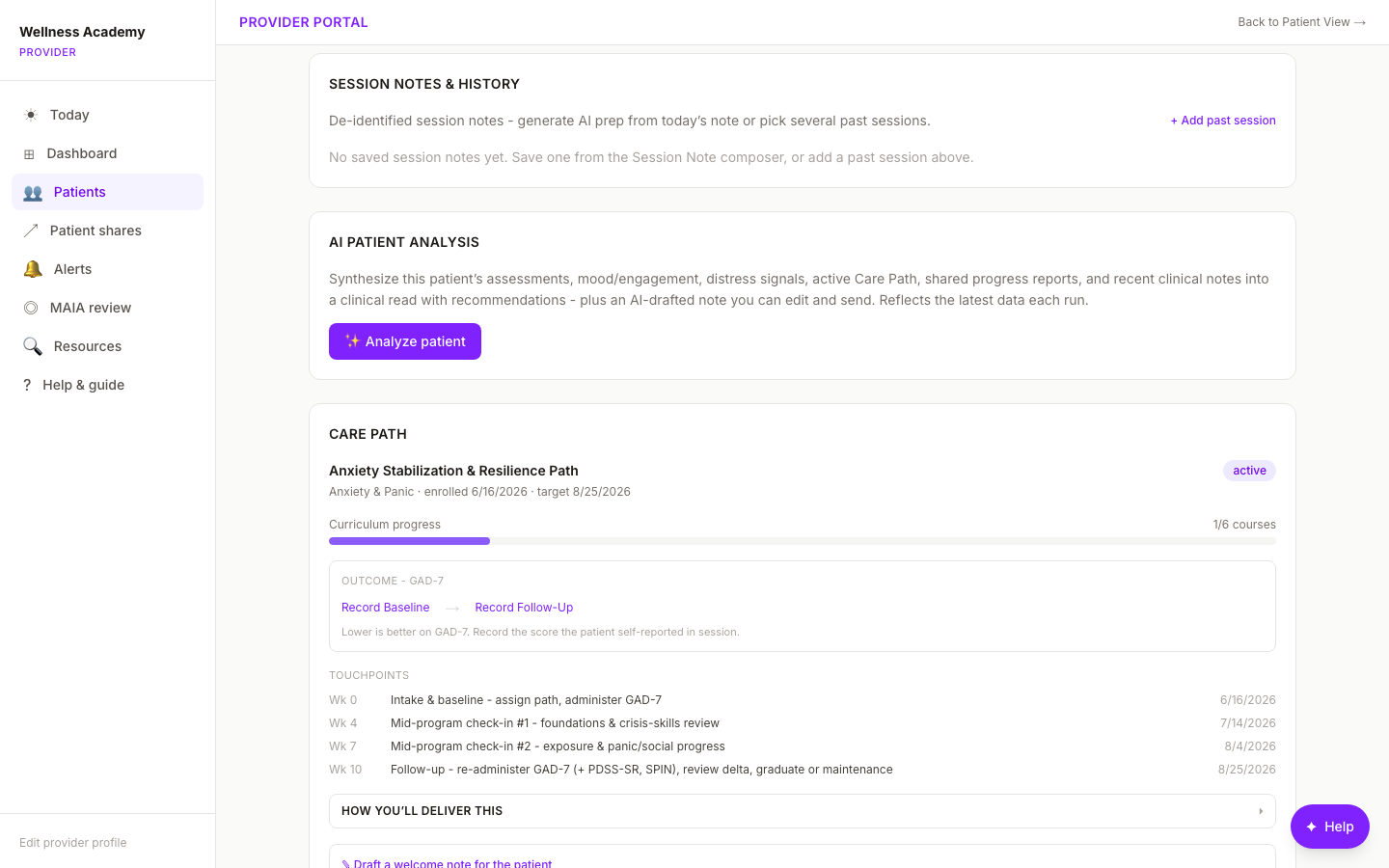
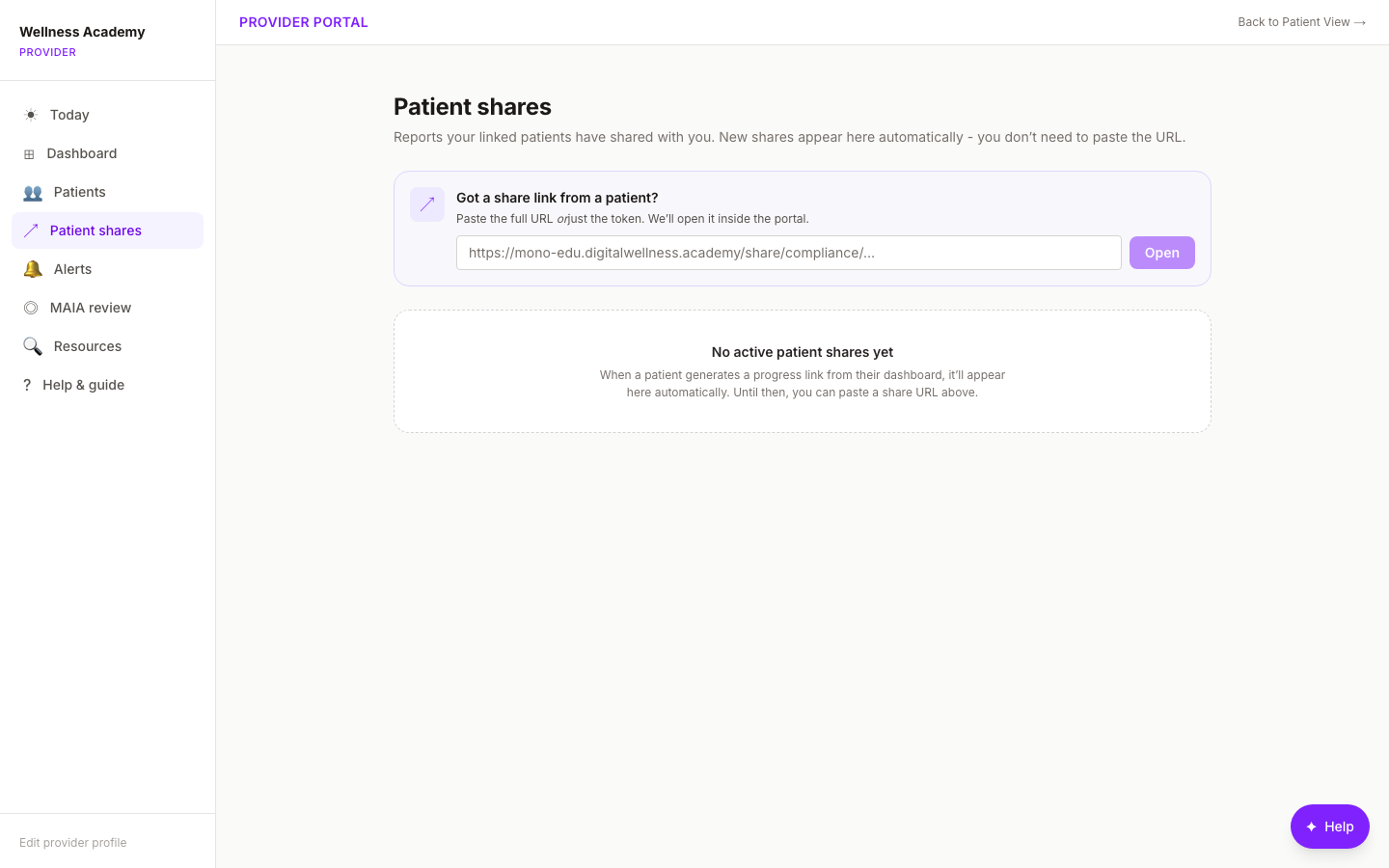
Ten real screens, following Dr. Chen from her morning dashboard to a signed session note. Click any screen to enlarge. No mockups.

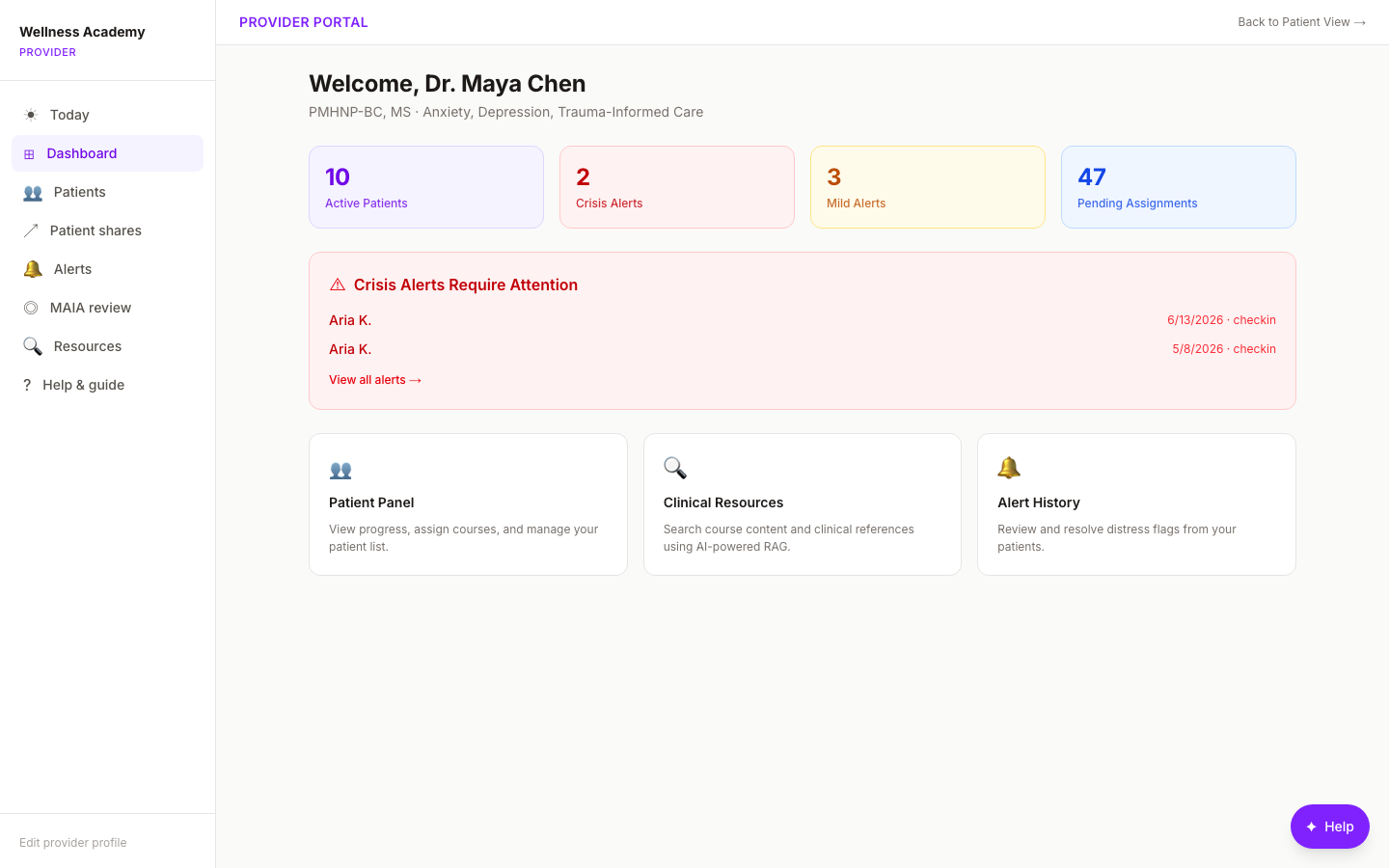
Dr. Chen opens to active patients, alert counts, and pending assignments, with the patients who need attention surfaced before anything else.

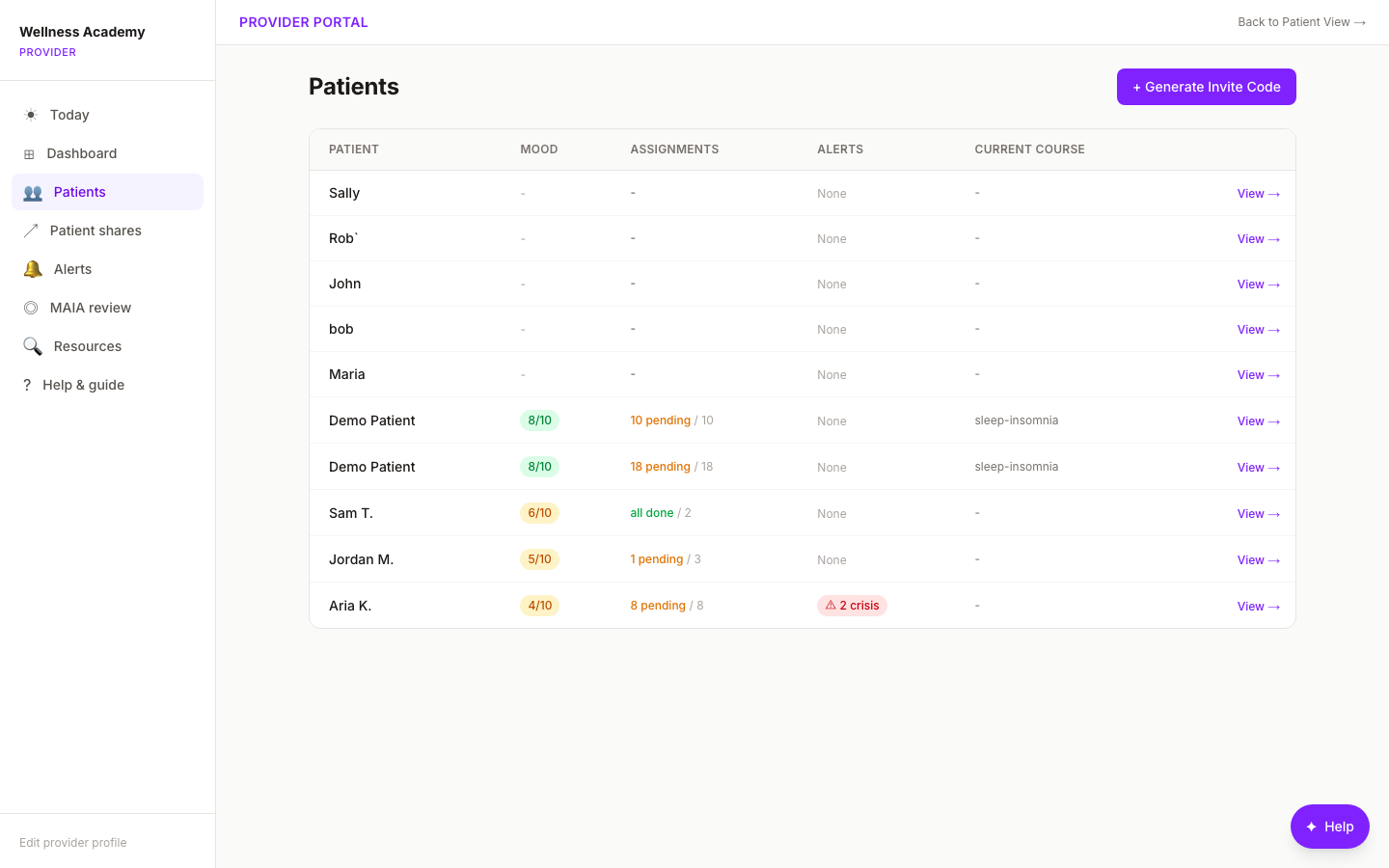
Every patient shows mood, assignment progress, open alerts, and current course, so a quick scan tells her who is moving forward and who has gone quiet.

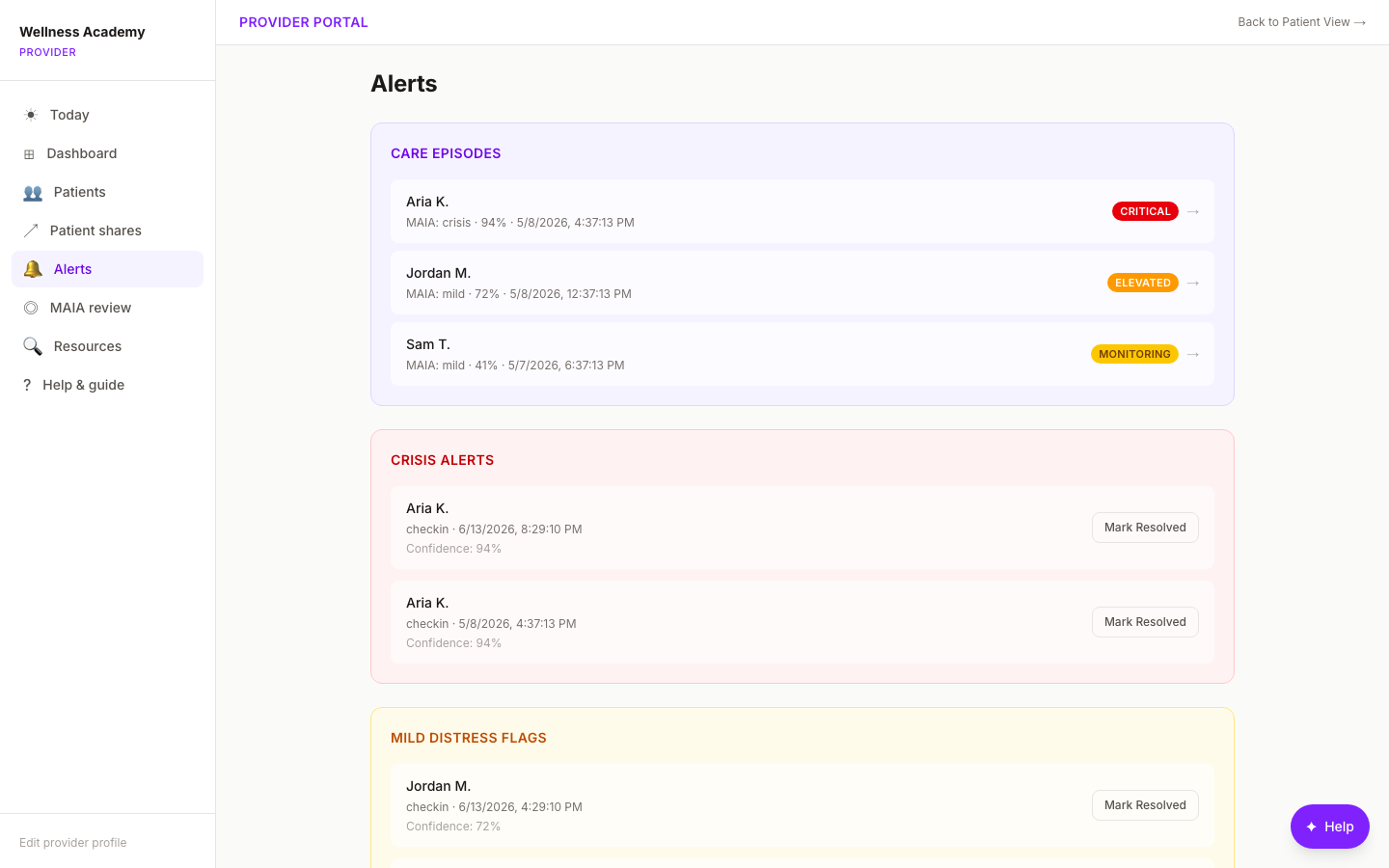
MAIA-scored crisis and distress flags are ranked by confidence and severity, with the context that triggered them, so she can reach out before the next session.

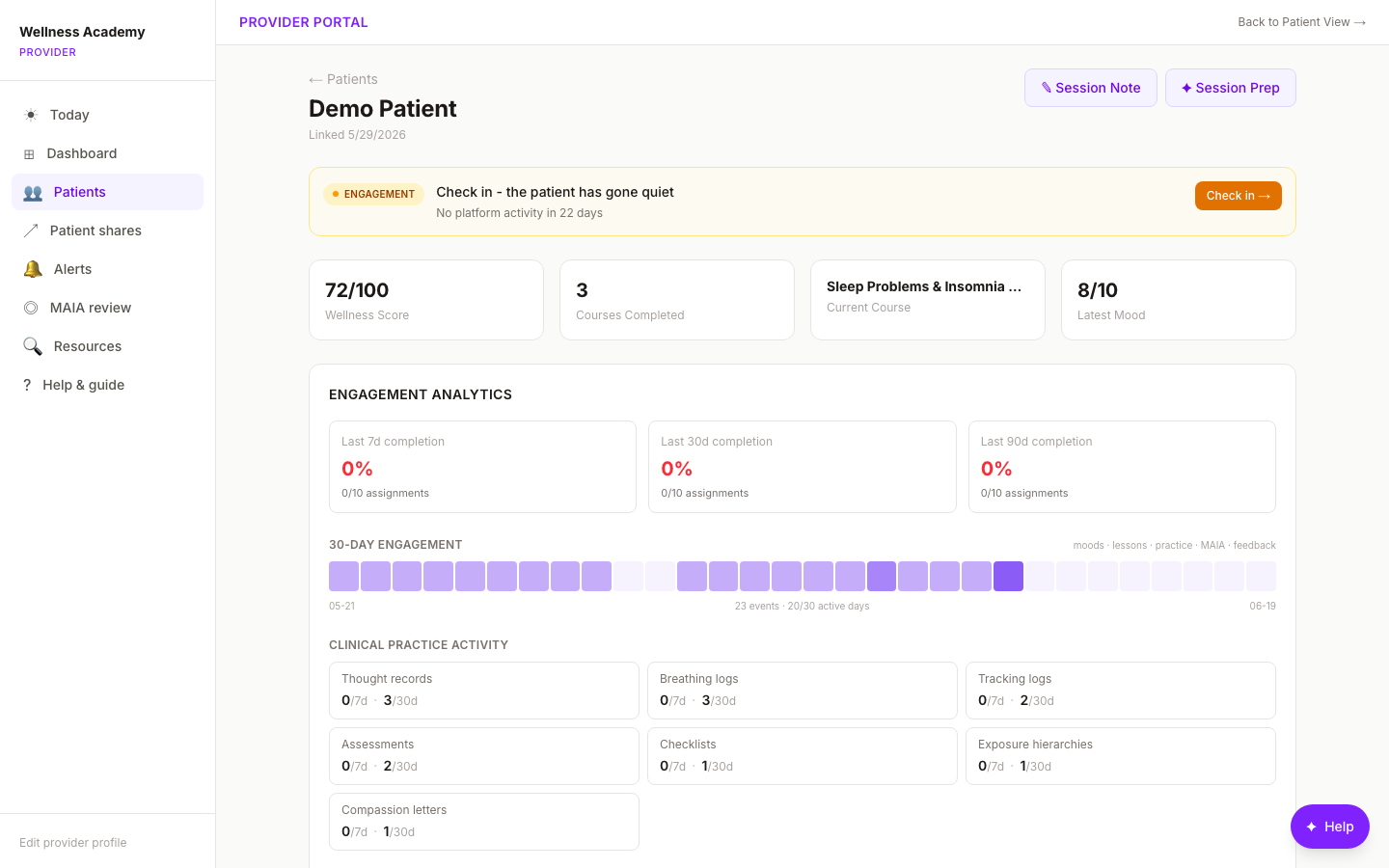
One patient's wellness score, course progress, engagement heatmap, and clinical-practice activity collected in one view, so she starts each session informed instead of catching up.

An advisory read synthesizes assessments, mood, distress, and the active care path into suggested next steps. It supports her judgement and never authors medication or risk content.

The SOAP composer auto-drafts from patient data and runs in the browser, never stored on our servers. It fills empty fields only. Medication and risk language stays with the clinician.

Dr. Chen reviews and labels a sample of MAIA's calls. Those labels feed a retrain gate, so a new safety model only ships when it measurably beats the current one on her practice's real data.

AI retrieval across the curriculum and references lets her pull the right lesson or reference to assign in the moment, grounded in the platform's own content.

Condition care paths track curriculum progress and GAD-7 baseline-to-follow-up outcomes, with lessons pushed straight to the patient's queue and a history that stays intact.

Read-only progress reports a patient chooses to share land here automatically. No PHI in email, every share scoped and revocable, the patient in control of what is shared.
Book a walkthrough and we will show you the portal with your conditions, your branding, and your typical week.
Request a demoDemand for care outstrips the hours in a week. When the only thing you can bill is the appointment, growth means more appointments, which means more hours or more clinicians. There is a ceiling, and burnout sits just above it.
A platform that extends care between sessions changes the unit economics: patients make progress on their own time, your sessions start further along, and a licensed program becomes a second line that does not consume another hour of your day.
A typical week gives each patient one hour of your time, and 167 without it.
Courses your patients can work through between visits, no extra clinician hours.
Validated assessments, including GAD-7 and PHQ-9, tracked as trends over time.
The safety classifier watches every input, so risk is surfaced the moment it appears.
Remote Therapeutic Monitoring is a real CMS billing category. CPT 98978 covers device-supply monitoring for cognitive behavioral therapy specifically, the same prescribed, between-session work a licensed care path already tracks.
The anonymous invite link and onboarding double as the patient and caregiver education a setup code requires.
Course engagement, check-ins, and mood entries are timestamped by day, the data a 16-of-30-day monitoring code is built on.
Reviewing and approving the AI-drafted treatment plan, plus the session itself, cover the interactive-communication requirement.
Extra review time beyond the first 20 minutes adds under the same monthly cycle.
Care that is prescribed and billed through insurance reads differently to a patient than a free-floating wellness app. Patients disengage from tools they see as optional extras and stay with ones that are part of their actual treatment. A licensed, billed care path gives patients a reason to keep showing up, which is also what keeps the monitoring data complete enough to support the code.
Digital Wellness Academy is the licensed technology. Your practice bills under its own NPI and determines what is billable for each patient and payer. Reimbursement is priced by the carrier and varies by plan.
The portal slots into the way you already work, not the other way around.
Generate an invite code. The patient creates an anonymous account and links to your practice.
Pick a condition care path and courses. The lessons land in the patient's queue, ready to practice.
Engagement, mood, and assessment trends update as the patient works, with distress flagged in real time.
A crisis flag reaches you with urgency and context, and the patient already sees the 988 Lifeline.
Open the patient view before the session, then let the composer draft the note you edit and sign.
Run the platform under your own name, colors, and domain. The relationship stays yours; the platform stays in the background.
Practices handling PHI run on a dedicated, BAA-eligible instance with PHI isolation. We sign a Business Associate Agreement before any PHI is involved.
Licensing scales with the size of your panel, not per seat. See pricing
Yes. Practices that handle PHI run on a dedicated, BAA-eligible instance with PHI isolation, and we sign a Business Associate Agreement first. The public learning instance is built to collect no personal identifying information at all, which keeps the surface area small.
No. The AI patient analysis is advisory. It summarizes what changed and suggests next steps, and you accept, edit, or ignore all of it. Medication content and risk determinations are never AI-authored. The clinician owns every decision and every word that gets signed.
No. It is mental health education plus clinician tooling, not a diagnostic device. MAIA is an early-warning safety layer that surfaces 988 and flags concerning language to you. It sits on top of real crisis services and never replaces clinical judgement or emergency care.
Every patient text is checked by MAIA before anything else. Crisis language surfaces 988 to the patient and raises a confidence-scored alert to you. You can review and label a sample of its calls, and those labels feed a retrain gate so the model only ships a new version when it measurably outperforms the current one.
Your practice runs the platform under its own name, colors, and domain, so patients see your brand and you keep the relationship. Setup is a branding pass and a domain, not a new build.
Licensing is a flat fee or a revenue share, scaled to the size of your panel rather than per seat. The pricing page has the current options, and a demo is the fastest way to size it for your practice.
Yes, the care path is built around CPT 98975, 98978, and 98980/98981, the setup, cognitive behavioral therapy monitoring, and treatment management codes for Remote Therapeutic Monitoring. Digital Wellness Academy is the licensed technology; your practice bills under its own NPI, and reimbursement is priced by the carrier and varies by plan.
Both. Nothing about the platform involves medication, so a psychology or talk-therapy practice gets the same white-label education, monitoring, and portal a psychiatric practice does. For a group practice with multiple clinicians, it also gives everyone a shared, reviewed curriculum to assign, so care quality does not depend on who a patient happened to see.
Book a walkthrough and we will show you the provider portal with your conditions, your branding, and a typical clinical week.
Request a demoPatient in crisis? They are routed to 988 immediately. The platform is education and clinician tooling, not a substitute for professional medical judgement or emergency care.
Two AI-native academies for founders. GTM OS is the go-to-market operating system you run your day in; 60-Day Founder turns an idea into investor-ready proof.
Build vertical AI products with platform discipline.
The operating system for psychiatric practice growth.
BizFrameHub: practical AI for professionals. TradesOS: run a more profitable trade business.
Master business English for tech professionals.
Master Colombian Spanish. Discover Bogotá.