Course Overview
The History and Development of Cognitive Behavioral Therapy
Cognitive Behavioral Therapy emerged in the 1960s through the groundbreaking work of psychiatrist Aaron T. Beck at the University of Pennsylvania. While conducting psychoanalytic research on depression, Beck made a revolutionary discovery: depressed patients exhibited systematic patterns of negative thoughts - "automatic thoughts" - that triggered and maintained their depressive symptoms. This fundamentally challenged prevailing psychiatric theory and launched the cognitive revolution in mental health treatment.
Simultaneously, psychologist Albert Ellis was developing Rational Emotive Behavior Therapy (REBT) based on similar principles. Together, Beck's Cognitive Therapy and Ellis's REBT established the theoretical foundation for what would become the most researched and validated mental health treatment approach in history. By the 1980s and 1990s, hundreds of randomized controlled trials demonstrated CBT's efficacy for depression, anxiety disorders, eating disorders, substance use disorders, insomnia, and chronic pain. The NIMH's landmark Treatment of Depression Collaborative Research Program (1989) found CBT equally effective as antidepressant medication - establishing it as a first-line treatment alongside pharmacotherapy.
Understanding the Cognitive Triangle
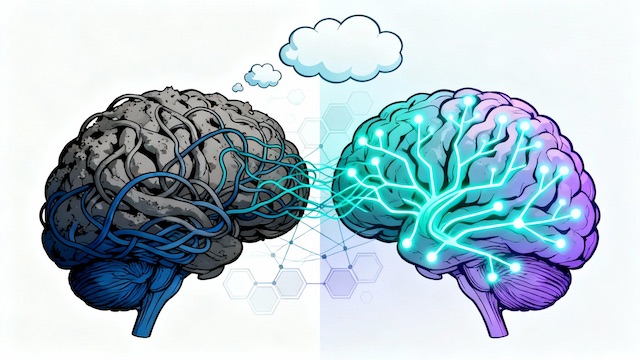
The cognitive model proposes that psychological distress results not from situations themselves, but from how we interpret and think about those situations. The cognitive triangle - thoughts, feelings, and behaviors - illustrates that these three elements exist in continuous bidirectional feedback loops. In depression, this manifests as the "negative cognitive triad": negative thoughts about oneself, the world, and the future. These automatic negative thoughts trigger depressed mood and hopelessness, which lead to behavioral withdrawal, which then generates more negative thoughts, perpetuating the depressive cycle.
In anxiety disorders, the pattern involves catastrophic interpretations of threat triggering intense fear and panic, leading to avoidance behaviors that prevent learning that the feared catastrophe won't occur. The avoidance maintains anxiety by confirming the belief that the situation was too dangerous to face. CBT provides a systematic method for identifying these patterns, testing whether automatic thoughts are accurate or distorted, and developing more balanced alternatives through cognitive restructuring - treating thoughts as hypotheses to be tested rather than facts to be passively accepted.
What You'll Master
- ✓Identify automatic thoughts and cognitive distortions (catastrophizing, black-and-white thinking, mind reading)
- ✓Use thought records to catch, examine, and restructure negative thought patterns in real-time
- ✓Apply behavioral activation protocols to counteract depressive withdrawal and inactivity
- ✓Construct exposure hierarchies and conduct gradual systematic desensitization for anxiety
- ✓Address core beliefs and schemas driving automatic thought patterns at the deepest level
- ✓Create relapse prevention plans to maintain gains long after treatment ends
Who This Course Is For
- ✓Individuals experiencing depression, anxiety, or persistent negative thought patterns
- ✓Anyone wanting to understand the connection between thoughts, feelings, and behaviors
- ✓Those seeking evidence-based techniques for managing emotional distress independently
- ✓People committed to developing long-term cognitive restructuring and behavioral coping skills
Research & Evidence Foundation
Built on peer-reviewed research spanning six decades and hundreds of randomized controlled trials demonstrating CBT's efficacy for depression, anxiety, and other mental health conditions.
JAMA Psychiatry Meta-Analysis - 2014 (184 Studies)
29% relapse rate with CBT vs 60% relapse rate with medication alone over 2 years
This definitive meta-analysis found no significant difference in acute treatment outcomes between CBT and antidepressants for major depressive disorder - but CBT demonstrated superior long-term outcomes. Patients responding to CBT had less than half the relapse rate of those treated with medication alone. CBT's "skills-based" nature creates lasting resilience against future episodes, while medication's benefits typically cease upon discontinuation.
Additional Key Research
- NIMH Treatment of Depression Collaborative Research Program (1989): The landmark multi-site RCT comparing CBT, interpersonal psychotherapy, antidepressant medication, and placebo in 239 outpatients found CBT equally effective as medication for mild-to-moderate and even severe depression, with significantly lower relapse rates at 18-month follow-up - establishing CBT as a first-line treatment.
- 2018 Lancet Psychiatry Meta-Analysis on CBT for Anxiety: Analysis of 101 studies involving 6,229 participants showed large effect sizes (0.73-0.88) across all anxiety disorder subtypes with sustained improvements at 6-12 month follow-up. Number needed to treat was just 2.3 - among the best outcomes in mental health treatment.
- Neuroimaging Studies (Stanford, University of Pittsburgh, UCLA): Functional MRI studies demonstrate that successful CBT produces measurable brain changes: decreased amygdala hyperactivity, increased prefrontal cortex activation, and enhanced functional connectivity between them - exactly the pattern seen in healthy individuals.
- CoBalT Trial - Lancet (2013): Adding CBT to medication for treatment-resistant depression more than doubled effectiveness: 46% response rate vs 22% for medication alone. At 12-month follow-up, 46% of the CBT group remained well compared to 24% medication-only.
- Prevention and Relapse Reduction: Meta-analyses show CBT reduces depression relapse by 60-70% compared to no treatment and approximately 50% compared to medication discontinuation. For anxiety disorders, CBT produces sustained improvements lasting 5-10 years in many cases.
Clinical Guidelines
The American Psychiatric Association, American Psychological Association, National Institute for Health and Care Excellence (UK), and World Health Organization all recommend CBT as a first-line treatment for major depressive disorder, generalized anxiety disorder, panic disorder, social anxiety disorder, OCD, and PTSD. Many guidelines now recommend CBT before or alongside medication due to superior long-term outcomes and absence of medication side effects.
Course Lessons (20 total)
Course preview available now. Full curriculum accessible after registration on the platform.
1
The Cognitive Triangle: Thoughts, Feelings, and Behaviors
Request access →
Lesson 2: Identifying Automatic Thoughts
Lesson 3: Cognitive Distortions: The Dirty Dozen
Lesson 4: Thought Records: Documenting Your Mental Patterns
Lesson 5: Cognitive Restructuring Techniques
Lesson 6: Behavioral Activation for Depression
Lesson 7: Exposure Hierarchy for Anxiety
Lesson 8: Problem-Solving Therapy
Lesson 9: Assertiveness and Communication Skills
Lesson 10: Relaxation and Stress Management Techniques
Lesson 11: Mindfulness in CBT Practice
Lesson 12: Core Beliefs and Schema Work
Lesson 13: Intermediate Beliefs and Assumptions
Lesson 14: Behavioral Experiments
Lesson 15: Activity Scheduling and Pleasure Prediction
Lesson 16: Relapse Prevention Planning
Lesson 17: CBT for Specific Disorders
Lesson 18: Self-Compassion in Cognitive Work
Lesson 19: Integration and Maintenance
Lesson 20: Building Your Personal CBT Practice