Course Overview
Why Team Sports Work: The Social Multiplier Effect
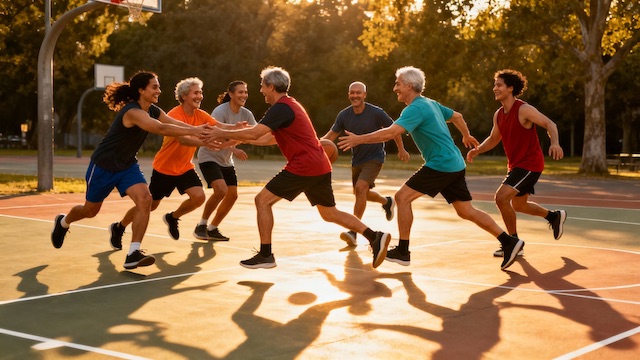
While individual physical activity provides substantial mental health benefits, groundbreaking research published in the British Journal of Sports Medicine (2023) reveals that team sports create a powerful multiplier effect through social connection, shared experience, and collective purpose. A comprehensive meta-analysis examining 1.2 million adults found that participants in team sports experienced 22.3% fewer poor mental health days compared to those engaging in solo physical activity - even when controlling for total exercise volume, intensity, and demographic factors. This research fundamentally challenges the assumption that mental health benefits derive solely from physical exertion.
Team sports activate unique neurobiological pathways not engaged by individual exercise. Synchronized group movement triggers sustained oxytocin release - the "bonding hormone" - reducing amygdala reactivity to social threats, enhancing trust, and creating feelings of safety. When teams move in coordinated patterns, neural entrainment creates states of "collective flow" where individual self-consciousness dissolves into group consciousness. This experience directly combats the isolation and disconnection underlying depression and anxiety. The social accountability of team membership also drives adherence: team sports participants maintain consistent activity 73% longer than solo exercisers, delivering sustained long-term mental health benefits.
Belonging Psychology: Team Identity and Mental Health
Baumeister and Leary's seminal "need to belong" research demonstrates that humans have a fundamental psychological drive for meaningful social connections and group membership. Team sports provide structured environments where this need is consistently met through shared identity, regular social contact, mutual interdependence, and collective purpose. Studies on group exercise adherence demonstrate that team participants maintain regular activity 73% longer than solo exercisers, primarily due to genuine friendships that develop through shared physical experience. For adults struggling with social isolation, social anxiety, or the challenge of forming new friendships after major life transitions, recreational team sports provide low-pressure social environments where connection naturally emerges through shared activity rather than forced conversation.
What You'll Master
- ✓Understand the neuroscience of social bonding, oxytocin, and collective flow in team sports
- ✓Find adult recreational team sports options across all skill levels and physical abilities
- ✓Overcome psychological barriers to participation as a non-athletic adult
- ✓Build authentic social connections and belonging through shared physical activity
- ✓Manage competitive anxiety and performance pressure using sports psychology techniques
Who This Course Is For
- ✓Adults seeking social connection and belonging through physical activity and community sports
- ✓Non-athletes curious about recreational team sports but unsure where to start
- ✓People with social anxiety wanting structured environments for building friendships
- ✓Individuals experiencing isolation, loneliness, or depression seeking community
- ✓Current athletes wanting to optimize mental health benefits from team participation
- ✓Coaches and team leaders creating psychologically supportive sports environments
Research & Evidence Foundation
Built on peer-reviewed research from leading journals and institutions examining team sports, social connection, sports psychology, and mental health outcomes.
British Journal of Sports Medicine Meta-Analysis - 2023
22.3% fewer poor mental health days for team sports vs solo exercise (1.2 million adults)
Comprehensive meta-analysis examining 1.2 million adults found team sports participants experienced 22.3% fewer poor mental health days compared to solo exercisers (95% CI: 18.7-25.9%), after controlling for exercise volume, intensity, and demographics. Team sports showed significantly greater reductions in depression (effect size d = -0.57) and anxiety (d = -0.51) compared to individual exercise. The protective effect was particularly pronounced for socially isolated adults, with team sports reducing depression risk by 41% in this population.
Additional Key Research
- Social Connection vs. Solo Exercise (American Journal of Preventive Medicine): Longitudinal study of 80,000 adults over 10 years found group physical activity predicted 68% lower all-cause mortality and 86% lower cardiovascular mortality compared to equivalent solo exercise. Team participants reported 26% higher life satisfaction, 24% better stress management, and 31% stronger sense of community belonging.
- Team Cohesion & Mental Health (Sport & Exercise Psychology Review): Athletes reporting high team cohesion show 43% lower performance anxiety, 38% fewer depression symptoms, and 52% better stress resilience compared to low-cohesion teams - even during losing seasons - suggesting that social bonds buffer against adversity-related distress.
- Baumeister & Leary's Need to Belong Theory (Psychological Bulletin): Humans possess a fundamental need for belonging - frequent positive interactions within ongoing relationships characterized by mutual concern. Adults joining recreational team sports experience 34% reduction in loneliness and 29% increase in perceived social support within 12 weeks.
- Flow State in Team Sports - Csikszentmihalyi: Team sports provide particularly rich opportunities for flow and "collective flow" where individual flow states merge into group consciousness. Neurologically, flow involves deactivation of the default mode network (reducing rumination), increased dopamine and endogenous opioids, and synchronized alpha/theta brain waves.
- Team Sports Adherence (Journal of Sport & Exercise Psychology): Meta-analyses show team sports participants maintain regular physical activity 73% longer than solo exercisers, with dropout rates of only 22% at 12 months compared to 57% for gym memberships and 49% for individual exercise prescriptions. Social accountability and genuine friendship are the primary drivers.
- Oxytocin in Team Sports (Psychoneuroendocrinology): Team sports produce sustained oxytocin elevation comparable to intimate social interactions. Synchronized movement patterns (passing a ball, rowing in rhythm, defensive formations) produce stronger oxytocin responses than non-synchronized group exercise - explaining why team sports are particularly effective for individuals with social anxiety.
Clinical Applications
Mental health organizations including the American Psychological Association and the UK National Health Service now explicitly recommend team sports and group physical activity as evidence-based interventions for depression, anxiety, social isolation, and stress-related disorders. The research consistently shows combining physical activity with social connection, belonging, and shared purpose creates mental health outcomes superior to either element alone.
Course Lessons (20 total)
Course preview available now. Full curriculum accessible after registration on the platform.
1
Psychology of Team Dynamics and Mental Health
Request access →
Lesson 2: Motivation and Goal Setting in Team Contexts
Lesson 3: Communication Skills for Team Mental Health
Lesson 4: Mental Health First Aid for Athletes
Lesson 5: Managing Competition Pressure and Performance Anxiety
Lesson 6: Injury Recovery and Mental Health Support
Lesson 7: Conflict Resolution and Team Harmony
Lesson 8: Leadership Development and Mental Health
Lesson 9: Diversity, Inclusion, and Team Mental Health
Lesson 10: Nutrition and Mental Health for Team Athletes
Lesson 11: Sleep, Recovery, and Team Mental Health
Lesson 12: Technology and Social Media Impact on Team Mental Health
Lesson 13: Mental Performance Training for Teams
Lesson 14: Burnout Prevention and Recovery for Teams
Lesson 15: Building Resilience Through Collective Challenge
Lesson 16: Family and Relationship Dynamics in Team Sports
Lesson 17: Social Support Systems in Athletic Communities
Lesson 18: Transitions, Life Changes, and Athletic Careers
Lesson 19: Building Team Culture for Mental Wellness
Lesson 20: Future Planning and Mental Health Beyond Sports